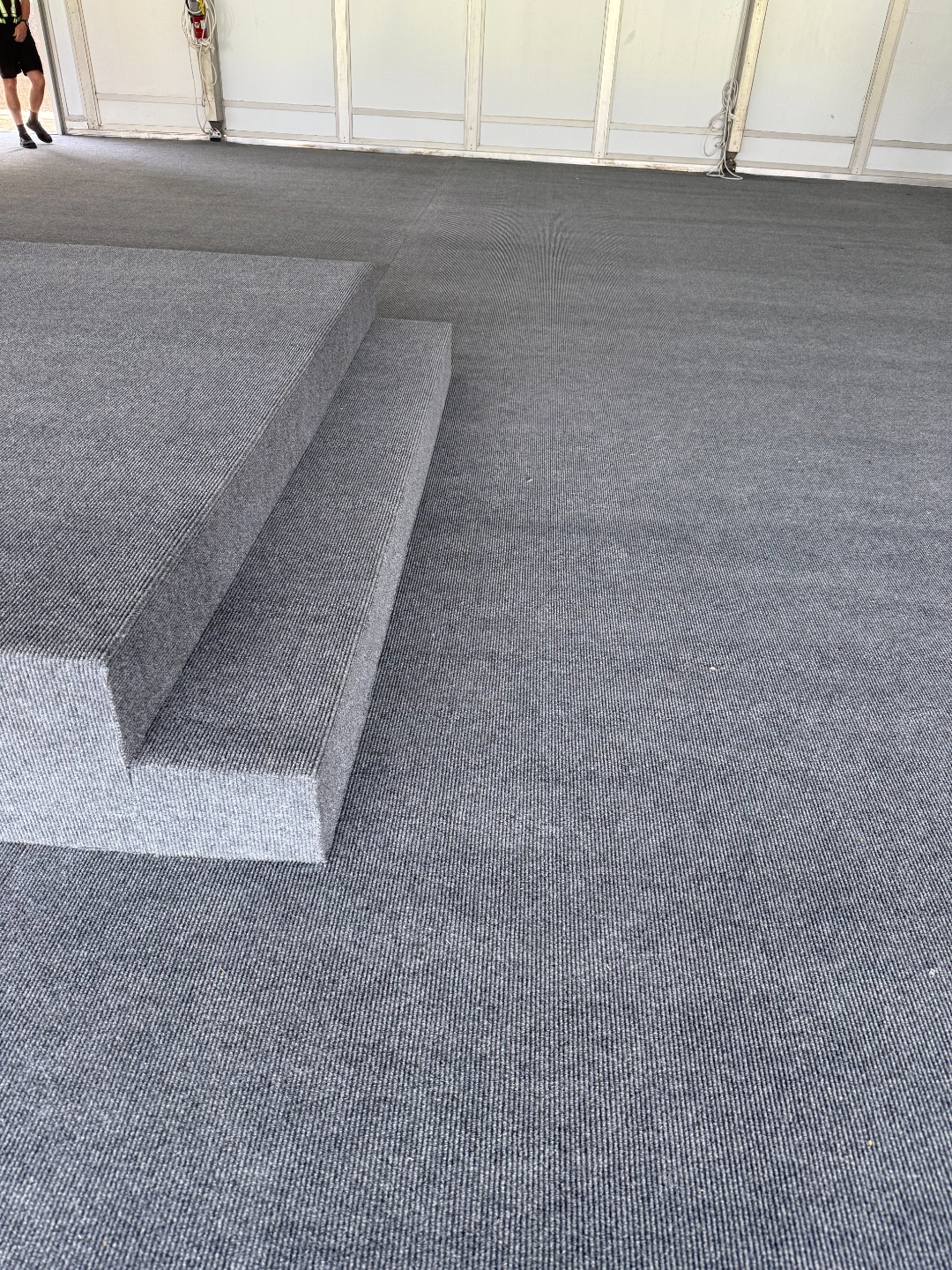
Flooring is almost always the first trade in and the last thing anyone thinks about. It has to be down before booths, furniture and lighting can go in, which means it usually happens overnight, in a window somebody else set. Most of the work that makes that possible happens weeks before the crew arrives.
Before a single roll ships, we need the floor plan, the square footage, the colors, the move-in window and what the surface underneath is — bare concrete, a ballroom carpet, a tent subfloor or a platform. Each one changes how the carpet goes down.
From the plan we work out roll layout: which direction the rolls run, where the seams fall, and how much material each area needs. This is where most of the time on install night is won or lost. A layout that puts seams down the middle of a main aisle, or that needs dozens of short pieces, adds hours.
Color matters here too. Our event carpet lines run a four-week lead time, so the floor plan and the color decision need to land well before the show, not the week of.
Our widest stock roll is 13 feet. Covering 10,000 square feet at that width is roughly 770 linear feet of carpet — before any allowance for trim, cutouts or step wraps. Wider rolls mean fewer seams, and fewer seams is the single biggest factor in how fast a floor goes down and how good it looks when it is done.
Every roll is heavy, every roll has to get from the dock to its spot on the floor, and every one has to be laid in the right direction so the surface reads the same across the whole room. On a ribbed floor like Fine Lines, direction is especially visible — rolls laid the wrong way show up as a stripe under show lighting.
1. Prep the surface. The floor gets swept clean. Dust and debris under event carpet show through, and they stop tape from holding. If the venue has its own ballroom carpet and we are putting a hard floor over it, it gets protected first with mesh tape.
2. Snap the lines. Booth edges, aisles and walls get marked so the first roll goes down straight. Everything after it follows the first roll, so if that one is off, the whole floor is off.
3. Roll out. Rolls go down in sequence following the layout, starting from a reference line and working outward.
4. Seam it. On a concrete slab, carpet is joined and held with high-tack double-sided seam tape. We stock it in 4.5-inch and 9-inch widths on 165-foot rolls. Over tent subfloors and platforms, carpet is stapled. Seams are where an event floor looks professional or looks rushed, so this is where the experienced hands go.
5. Trim and wrap. Edges get trimmed tight to walls, columns and booth lines. Stages, risers and steps get wrapped, with the carpet folded and fastened around each edge so there is no loose lip for anyone to catch a heel on.
6. Walk it. Before the next trade comes in, the floor gets walked end to end for bubbles, lifting seams and loose edges. Fixing those now takes minutes. Fixing them after furniture is in takes hours.
The same floor has to come up, usually even faster, at the end of the show. If the plan is to reclaim the carpet rather than dumpster it, that changes how it goes down: where the seams are, how much is stapled, and how the step wraps are done. On stapled installs the seam lines, where the staples sit, get cut out at strike, and staples are pulled from the large field area so the clean material can be baled. That is roughly ten percent lost to seam lines and step wraps, and roughly ninety percent back. We wrote about what happens to event carpet after the show if you want the full process.
Not sure which floor to put down in the first place? Start with our booth flooring comparison and what carpet weight means for your show.
Send us the plan, the dates and the city. We coordinate the crew, the freight and the timeline so the floor is down before doors open — installed nationwide out of Baton Rouge, Nashville and Orlando.
It depends on the square footage, the shape of the floor plan, the move-in window and how clear the floor is. Most of the time is won or lost before the crew arrives, in the roll layout. A large open hall with a clean slab goes down far faster per square foot than a floor full of small booths and islands.
On a concrete slab, event carpet is joined and held with high-tack double-sided seam tape. Over tent subfloors and platforms, it is stapled. Stages, risers and steps are wrapped, with the carpet folded and fastened around each edge.
At a 13-foot roll width, 10,000 square feet is roughly 770 linear feet of carpet, before allowing for trim, cutouts and step wraps. Wider rolls mean fewer seams and a faster install.
Late floor plan changes, late freight, other trades or equipment on the floor, a dirty slab, and complex layouts with curves, islands and many small booths.
Yes. At strike, the seam lines where the staples sit are cut out, and staples are pulled from the large field area so the clean material can be baled for recycling. Roughly ten percent is lost to seam lines and step wraps, and roughly ninety percent comes back.